The Town Council achieves ‘zero debt’ after paying 300 million euros and makes the biggest tax cut in the history of Estepona
An average reduction of 20% will be applied to this year’s IBI bill.
The mayor has said it is “a milestone for the town”, achieved “in record time” thanks to economic management marked by “responsibility, efficiency and good use of public resources”.
García Urbano has said that a new stage is opening in economic management in which “the significant efforts” that until now have been used to pay off debt (an average of 60,000 euros a day) can be directed to more public investment, to strengthening services and to increasing support for families and the productive fabric.
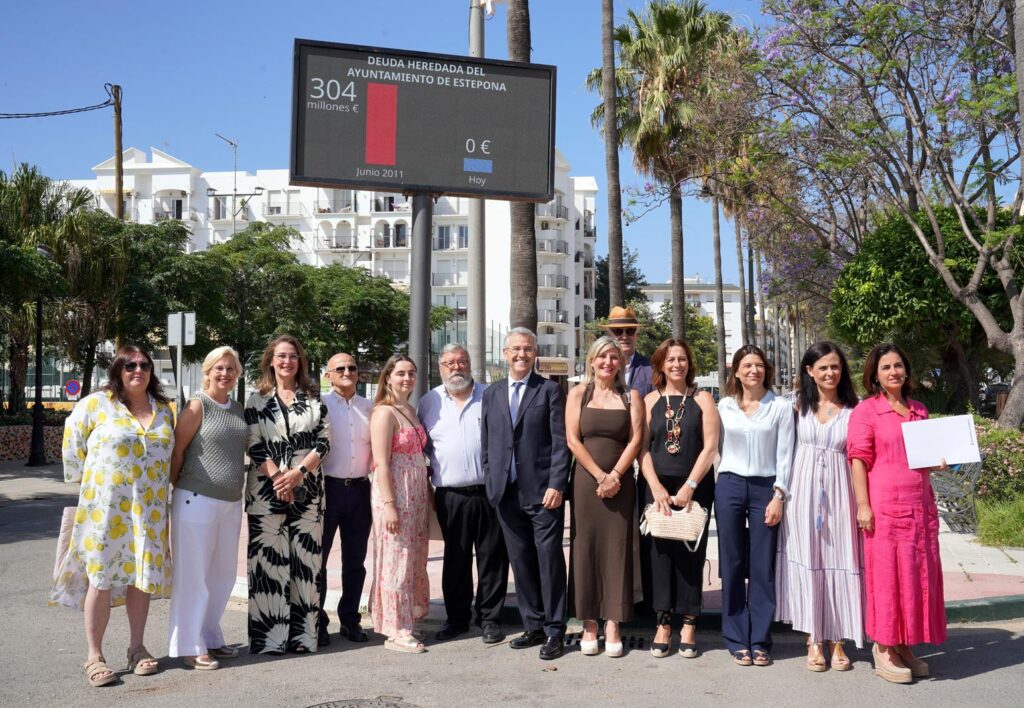
The mayor of Estepona, José María García Urbano, has announced the achievement of “a milestone for the town” after paying off the entirety of the more than 300 million euros of debt that Estepona Town Council had accumulated up to 2011. With this ‘zero debt’ achieved, he has said that “the biggest tax cut in the history of the town” will be carried out, which will already take effect on the Property Tax (IBI) bill for this 2025 financial year, with an average reduction of 20%. In this way, IBI in the town will reach a cumulative reduction since 2011 of 50% thanks to the measures taken over these years. In addition, the mayor has said that the Town Council will continue to study new reductions in the tax burden for the coming years if the economic situation of the municipal coffers allows it.
García Urbano explained that this year more than 26 million euros have been paid to meet the commitment to achieve full repayment of Estepona Town Council’s financial debt; a fact that has been certified by the municipal Audit Office.
The first councillor said that “with municipal management marked by responsibility, efficiency, austerity and good use of public resources” the repayment of the enormous debt that previous governments generated with public administrations, bodies, companies, suppliers and financial institutions has been carried out in record time”, which has also made it possible to save significant amounts in the financial interest it generated. “Today we leave behind one of the most ill-fated chapters in the history of Estepona and move forward with more strength towards an excellent town”, he asserted.
In this regard, he recalled that Estepona Town Council was at the top of the most indebted town councils in Spain, with a debt of 4,600 euros per inhabitant, while valuing “the great budgetary effort” that has been made to end this financial burden from the past. Specifically, since 2011 an average of 60,000 euros a day has been devoted to paying this debt. “How much more could have been done during this period if those amounts had gone towards facilities, services and support for families. For example, 16 hospitals, 2,550 remodelled streets, 2,100 social housing (VPO) homes, 25 underground car parks like the one in Plaza del Ajedrez or 182 kilometres of coastal corridor”, he added.
He likewise stressed that in these years the municipal accounts have been put in order and Estepona Town Council has become a serious and exemplary administration that has not generated debt, since all the facilities and projects carried out within the great transformation and modernisation of the town have been paid for.
In relation to the repayment of the inherited debt, it is worth highlighting: the elimination of all the unrecorded invoices, the so-called ‘invoices in drawers’ (33 million euros); the payment of the entire debt inherited with the Junta de Andalucía for the improper or unjustified use of grants awarded to the previous socialist government (6 million euros); the payment of the debt to the General Treasury of Social Security (60 million euros) and to the Tax Agency (18 million euros); as well as the payment of more than 90 million euros of the Supplier Payment Plan, among other items.
On the other hand, the mayor explained that saving and responsibility in spending have been decisive in the economic management needed to repay this debt, with a multitude of measures that have contributed to eliminating superfluous spending or the squandering of public resources. He also stressed the importance of the elimination in 2011 of the municipal companies, which had become “instruments to evade the transparency, control and administrative law that governs the functioning of local Administration, being tools for uncontrolled spending by predecessor governments”. In this regard, he indicated that, in these 14 years, “all economic and municipal management is audited and controlled with the guarantees of the Audit, Treasury and Secretariat bodies.
In parallel with all this, the Town Council has been developing major projects and initiatives that have transformed the town with a management model focused on quality of life, modernity, the maintenance of traditions, and the promotion of culture and sport.
Thus, initiatives stand out such as the ‘Jardín de la Costa del Sol’ Town Centre Beautification Plan, which has enabled the urban regeneration and beautification of more than 130 streets and squares; the Coastal Corridor, already 95% complete and which will make it possible to walk the entire coastline of the municipality along a pedestrian path; the construction of the Fairground, Sports and Leisure Park; the Athletics Stadium; the Felipe VI Theatre Auditorium; the Orchid Park, a benchmark at international level; or the Mirador del Carmen Cultural Centre, with exhibition halls, a conservatoire, an auditorium and the eight-floor Contemporary Cultures Library.
The construction of the new pedestrian boulevard into which the old N-340 road has been transformed also stands out, creating one of the longest seafront promenades in the country, the remodelling of Calle Terraza or the Municipal Car Park Plan, which already totals 2,000 parking spaces under the formula of 1 euro during the day and 3 euros for 24 hours. To the four current sites will be added those under construction around the Iglesia del Carmen, and the one at the Bulevar Parque Central, as well as the one planned in the La Lobilla area. Procedures have also been started to take back the La Viña car park, until now in private hands under a municipal concession from previous governments, and to include it in the municipal network.
The Town Council also took an important step by taking on the construction of the High Resolution Hospital, with an investment of 15 million euros, and its subsequent transfer to the Junta de Andalucía for equipping and bringing into service.
García Urbano has said that “a new and significant stage is now opening in the economic management of the town”, in which those large sums of money that until now were used to pay off debt can be directed to more public investment, to strengthening municipal services and increasing support for families and the local productive fabric.
Thus, the Town Council has approved at the full council meeting allocating 8.3 million euros to new projects, improvements to the town and more cultural and sports activities. Specifically, it has approved incorporating into this year’s budget 7.7 million euros from the surplus achieved in 2024 for new investments such as a comprehensive remodelling and infrastructure plan that will make it possible to attend throughout the year to the improvement works that may arise in public infrastructure across the whole municipality. In addition, several major actions in neighbourhoods are planned, and long-awaited projects such as the construction of a velodrome or the start of the procedures for the new Guadalmina river path. In addition, the allocation for cultural and sports activities and for the Mirador del Carmen Cultural Centre is increased by a further 650,000 euros.
The conservation and refurbishment of municipal buildings and a new asphalting plan are other actions to which new funds will be allocated.
In relation to economic management, it is worth recalling that the settlement of the 2024 municipal budget has produced historic figures, with all economic indicators in positive territory, with a surplus of more than 45 million euros and budgetary stability of 24 million euros, a record figure since records have been kept. Likewise, the average supplier payment period stands at 12 days, placing Estepona Town Council at the head of administrations with prompt payment and leaving behind the delays of 1,492 days that previous governments dragged along.